


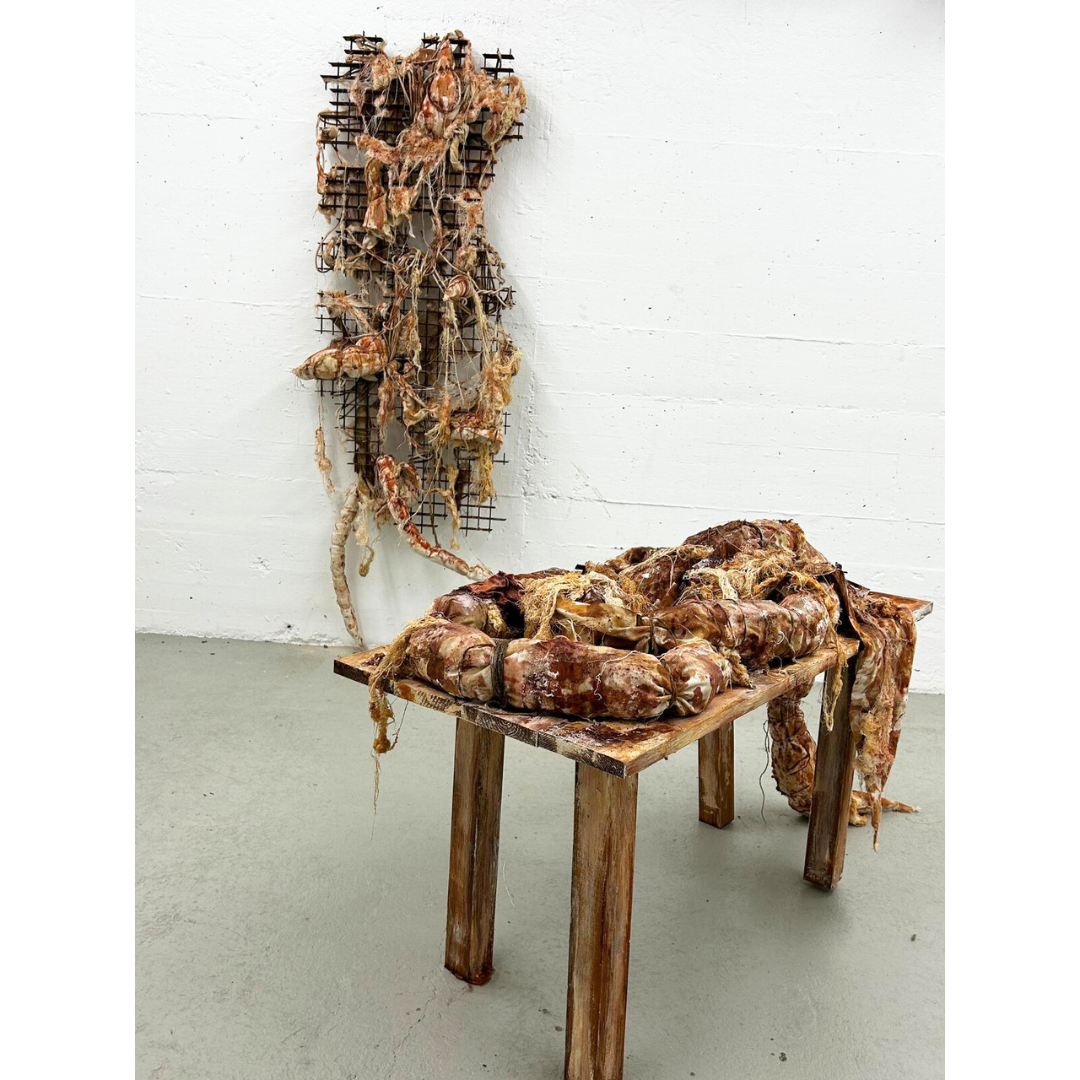
My Guts on Your Table, 2023
Found wood, beeswax, rusted canvas, string and rope
Ophélie Napoli's My Guts on Your Table engages the viewer at the threshold between conscious and subconscious, presenting neglected or repressed realities that inevitably resurface. Echoing Adorno and Horkheimer's (1989, p.3) assertion that "the fully enlightened earth radiates disaster triumphant,"1 Napoli projects humanity's suppressed fears and anxieties through fragmented, organic forms. The work registers "the upheavals of urban life" causing development of "an organ protecting against…external environment" (Simmel, 1950, p.411),2 dissecting societal tendencies towards avoidance and denial by confronting the viewer with the abjection of My Guts—whose guts remains inconclusive, while the horizontality converts vertical human form into “gruesome fragments” (Nochlin, 2001, p.22).3
Deep Time and Absurdity: Napoli invokes humanity’s evolutionary past and the absurdity of existence, juxtaposing biomorphic forms that recall marine organisms and primitive life. The work underscores the repetitive and cyclic "generation and degeneration" of life (Pincus-Witten, 1987, p.51),4 using exaggerated seriality to amplify meaning through absurdity (Nixon, 2002, p.11).5
Usurping Institutional Framework: The presentation of the work is on a limping table, which though still appears as if in motion, which problematises how viewers historically were meant to "lose [themselves], forget [themselves], extinguish [themselves] in the artwork" (Adorno, 1970),6 critiquing the the institutional framework that predominates.
Reclamation of Space: The visceral display of insides demonstrates both vulnerability and aggression, unsettling traditional power dynamics and the viewer’s gaze. Napoli’s approach emphasises a delicate interplay of manipulation and submission... creating a “push and pull” between care and violence, ultimately reclaiming the space and autonomy by forcing recognition on its own terms.
Notes:
1 Adorno, T. & Horkheimer, M. (1989). Dialectic of Enlightenment, trans. John Cumming. New York: Verso.
2 Simmel, G. (1990). The Philosophy of Money, ed. D. Frisby, trans. T. Bottomore & D. Frisby. Routledge.
3 Nochlin, L. (2001). The Body in Pieces: The Fragment as a Metaphor of Modernity. Thames & Hudson.
4 Pincus-Witten, R. (1987). Postminimalism. Thames and Hudson.
5 Nixon, M. (ed.). (2002). Eva Hesse. Essays and interview by C. Nemser, R. Krauss, M. Bochner, B. Fer, A. M. Wagner, and M. Nixon. OCTOBER files 3. The MIT Press.
6 Adorno, 1970),6 Adorno, T. W. (1970). Ästhetische Theorie. Suhrkamp Verlag
Ships from the United Kingdom
Couldn't load pickup availability




Close Considerations
Ambiguous Dimensions and Presence: The carefully balanced dimensions of Napoli’s table place it ambiguously between function and sculpture, reinforcing its unsettling identity. Its tactile materials, such as beeswax and iron oxide, register the gradation of time, while maintaining a “fragile and tenuous quality" (Lippard, 1992, p.185).1 The viewer navigates an intimate engagement, becoming part of its ambiguous presence (Krauss, 1978, p.268).2
Movement and Structural Instability: Napoli creates the illusion of motion by positioning the table as if walking, destabilising traditional perceptions of static support. This tension between containment and movement challenges the viewer’s passive engagement, as "the object has not become less important" but "less self-important" (Greenberg, 1993, p.252),3 suggesting both "solicitation and refusal" (Nixon, 2002, p.173).4
Material Dialogue: In conversation with a nearby ephemeral wall sculpture, the grounded table symbolises a struggle against confinement. Contrasting crude and harmonious textures, Napoli’s biomorphic forms express a "vigorous biomorphism and sense of craft" (Pincus-Witten, 1987, p.47),5 negotiating the dynamic between structural rigidity and organic decay.
Table as System and Complicity: The table itself forms part of the artwork’s critique of institutional frameworks by reflecting societal patterns of creation and destruction, against disciplinary power structures that "arrest or regulate movements" (Foucault, 1977, p.220),6 while confronting complicity within these systems.
Post-Climactic Decay: Suggesting post-orgasmic exhaustion, Napoli’s work evokes cycles of vitality and inevitable decay. Embodied through organic materials and "highly sensuous textures" (Lippard, 1992, p.187), the work also speaks to humanity’s "lack of being," defined through ongoing absence and constant striving for something (Sartre, 2003, p.112).7 The work investigates the human condition, from the very base animalistic feelings, to the very complex existential ones.
Notes:
1 Lippard, L. (1992). Eva Hesse. New York: Da Capo Press.
2 Krauss, R. (1978). "Grids" in October, pp.3–23.
3 Greenberg, C. (1993). Modernism with a Vengeance 1957 – 1969. Vol. 4 of The Collected Essays and Criticism, edited by J. O’Brian. The University of Chicago Press.
4 Nixon, M. (ed.). (2002). Eva Hesse. Essays and interview by C. Nemser, R. Krauss, M. Bochner, B. Fer, A. M. Wagner, and M. Nixon. OCTOBER files 3. The MIT Press.
5 Pincus-Witten, R. (1987). Postminimalism. Thames and Hudson.
6 Foucault, M. (1977). Discipline and Punish: The Birth of the Prison, trans. Alan Sheridan. Penguin Books.
7 Sartre, J. P. (2003). Being and Nothingness, trans. Hazel E. Barnes. Routledge.


Process
Work Comes Out of Work: My Guts on Your Table began from intuitive material exploration, actively engaging physical processes over conceptual planning, embodying Richard Serra's notion that "work comes out of work" rather than thought alone. Her method emphasises accidental discoveries as "unknown forms of life," merging chance with deliberate creation (Focillon, 2007, p.36),1 maintaining dynamism within structure.
Disruption of Form: Originally titled Without Tail or Head, the work defied clear beginnings or conclusions. Its reconfiguration disrupts linear narratives, reflecting Sartre's (2003, p.111) understanding of being defined by absence: “constituted in its being by…what it is not.”2
Temporal Illusions: Napoli process works against linear progression through continual transformation, exceeding fixed boundaries and embracing displacement (Melville, 2003, p.170).3 Her practice suggests humanity structures time according to biological rhythms, questioning artificial divisions between origins and endings.
Material Interplay: By repurposing existing artworks, Napoli underscores a cyclical process where materials mutate organically. This method a dialogue between care and violence, embodies both creation and destruction, healing and hurting, growing and aging.
Restricted Agency and Commodification: Ultimately constrained onto the table, the piece suggests loss of autonomy and the commodification of creative expression. This act echoes Adorno's (1970) critique of total administration, where viewers and artworks alike lose agency, forced into predetermined frameworks of institutional display and consumption.4
Notes:
1 Focillon, H. (2007). In Praise of Hands: Manual Skill and Its Practice. Zone Books.
2 Sartre, J.-P. (2003). Being and Nothingness, trans. Hazel E. Barnes. Routledge.
3 Melville, S. (2003). "What was Postminimalism?" In Art and Thought, edited by D. Arnold and M. Iversen.
4 Adorno, T. W. (1970). Ästhetische Theorie. Suhrkamp Verlag


References
Spatial and Temporal Grid as Critique: Napoli uses the grid as described by art historian Rosalind Krauss (1978, p.3): ”flattened, geometricised, ordered, anti-natural,”1 to critique modernity and artistic autonomy. Her biomorphic reliefs challenge grid-imposed structure, echoing art critic Robert Pincus-Witten’s (1987, p.47) “vigorous biomorphism” found in Eva Hesse's work,2 revealing inherent tussle between chaos and order (Nixon, 2002, p.175).3
Diaspora, Subalternity, and Identity: Napoli’s perspective reflects Steven Vertovec’s (2009) “diaspora consciousness,” highlighting multiple identifications that position her simultaneously “‘home away from home,’ ‘here and there.’”4 The artistic concern can be discerned through Homi Bhabha’s (1994) "spatialisation of the subject," expressing ambivalence between autonomy and subalternity through cultural displacement and fragmented identities.
Ritual: By referencing communal rituals like The Last Supper, Napoli critiques artistic consumption within the predominant institutional framework, how art, like food, is dissected and absorbed. Her sculptures symbolise an offering of self-exposure, connecting bodily consumption to artistic commodification, thus mirroring Nietzsche’s (1967, pp.176-7) assertion that “humans crave for and enjoy cruelty.”6
Sorrentino, Surrealism, and Alienation: Inspired by Paolo Sorrentino’s films and surrealist traditions, Napoli’s installations unsettle everyday experiences, exploring the seductive charm of repulsion and attraction. Such work appears “both alien and familiar” (Sirmans, 2016, p.40).7
Louise Bourgeois: Influenced by Louise Bourgeois, Napoli integrates structural supports into her sculptures, where supports actively interact with forms they carry: “the structure and the object are coextensive” (Judd, 2016, p.164).8 Rejecting fixed regeneration cycles, her works exist in transitional flux.
Notes:
1 Krauss, R. (1978). "Grids" in October, pp.3–23.
2 Pincus-Witten, R. (1987). Postminimalism. Thames and Hudson.
3 Nixon, M. (ed.). (2002). Eva Hesse. Essays and interview by C. Nemser, R. Krauss, M. Bochner, B. Fer,
4 Vertovec, S. (2009). Transnationalism. Routledge.
5 Nietzsche, F. (1967). Beyond Good and Evil, trans. Helen Zimmern. George Allen and Unwin Ltd.
6 Fowle, K., Sirmans, F., & Morgan, J. (2016). STERLING RUBY. Phaidon.
7 Judd, D. (2016). Complete Writings 1959–1975. Judd Foundation.