


Untitled (041A7608), 2024
29.7 x 42.0 cm
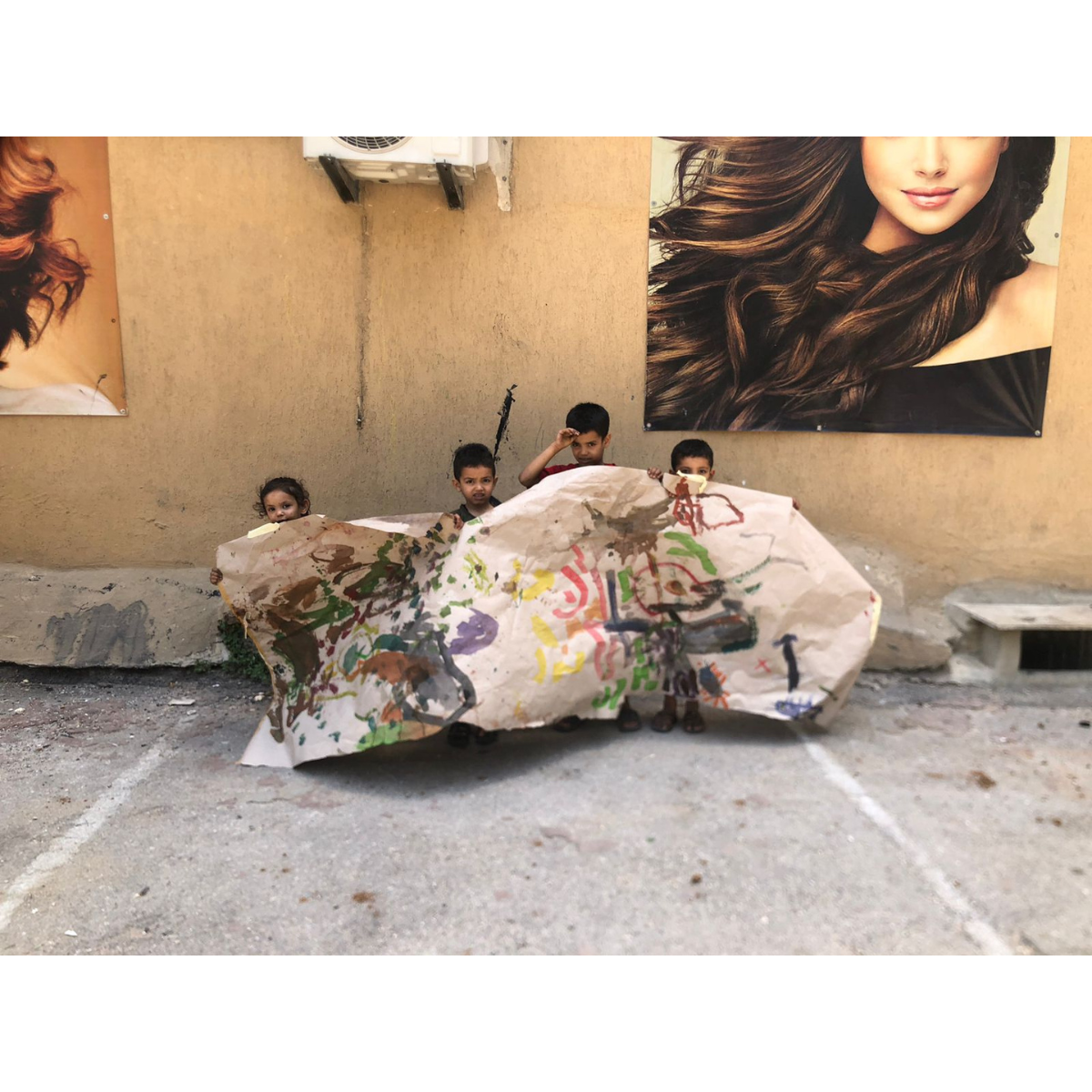
Hatim came to Lebanon from Syria with his family about a year or so after Omar, and became part of Streetcolors through the painting activities. He made this painting when he was eight, with at the Streetcolors exhibition his works drew attention beyond expectations, according to Karine Wehbé, the founder of the organisation. She was happy to see him find real pleasure in painting, demonstrating a facility to paint, draw, and control shapes. Initially when she started working with him, he was very sensitive, and reserved before gradually expressing himself more and through bigger and bigger paintings
Medium: Painting
Frame: unframed
Ships from the United Kingdom
Couldn't load pickup availability



Close considerations
This dramatic composition of a robot-like figure within Hatim’s personal context of life in war under the lens of modern weapons of destruction feels both childlike and serious. It is simple to be grasped at the first glance but also complex to read as a subconscious rendering. It is built from broad opaque passages with visible brush pressure and reworking, stabilised by a geometric mass. The surface is dominated by a monochromatic orange ground laying the backdrop. Against this seems to rise a central, simplified figure from an empty base in pale blue-grey, with small mint-green accents on, above and below what seems like the black head or helmet of the figure. The texture is rendered with scumbles, wiped gestures, and incidental or intentional smudges, making the background especially appear like its in motion.
The palette is psychological: the expansive, radiating, hot and enveloping atmosphere of the orange base that reads as theatrical and energetic. This is juxtaposed with the cool, muted, stony central figure, which has a quieting effect. The black at the head of the figure locks in the composition pulling our attention upward. And the mint-green can read as a form of glow emanating from within the figure, as a soft interior.
A transcendent figure untouched by the fire all around it? The figure, intended to be a robot, with the top black form resembling a visor and the arm-like but not quite protrusion on the left from the torso, and a base that looks like it is seated in the pose taken by the children at Streetcolors sitting on the ground when creating their artworks. The soft mint in a way becomes the window inside the black, and can be read like an eye. It feels like a post-human form.
The post-human reading of the figure ties into our contemporary lives, where the head as a visor is an opaque and anonymous mediating entity. This becomes even more threatening when considered in the context where Hatim and his family exist.


Process
The figure and the background are built through translucent layered passes, wipe marks, tonal variations, occasional grey smears and black patches, thus capturing the process of the making as evident. There is an anti-finish quality that gives it its raw charm. It is immediate and vital, contrasting with what could be described as mature and academic work.


Visual echoes
The painting recalls the blunt, cartoon-like figure and the heavy head mass in Phillip Guston’s close-up compositions, Jean Dubufffet’s deliberately raw handling and construction style leaving the smears and underlayers visible, while the hot orange field against the cool central figure recalls Karel Appel energetic, simplified tactile brushwork of childlike constructions set against an aggressive atmosphere.